Posts

How to Choose the Best Business Structure for Your Start-up?

Image
  How to Choose the Best Business Structure for Your Start-up? Introduction Selecting the appropriate legal structure for your company is among the most critical choices you will need to make at the outset of your business. Your selection will impact not just your tax payments but also the amount of documentation that your company will need to undertake and your own personal responsibility. Therefore, how can you determine which business structure is best for your new venture? To decide which business structure is suitable for your startup, you need to assess various aspects such as liability, tax implications, incorporation expenses, and ongoing administration and record-keeping requirements. In this blog, we will describe various business structures that you can adopt for your business. Sole Proprietorship The simplest form of business structure is  Sole Proprietorship , which typically involves a single individual who owns and runs the business. If you don't establi...

Alteration of Memorandum of Association

Image
Alteration of Memorandum of Association The Memorandum of Association (MOA) is a legal document that sets out the constitution of a company and defines the company's objectives, powers, and scope of operations. The MOA is one of the documents required to be filed with the registrar of companies during the incorporation process. The MOA is a vital document that outlines the purpose of the company, its goals, and how it intends to operate. Types of MOA as per companies act 2013 As notified under Schedule I of the companies act 2013 following are the types of MOA that different types of companies can adopt: Table A: Company limited by shares Table B: Company limited by guarantee and having a share capital Table C: Company limited by guarantee and not having a share capital Table D: Unlimited company having a share capital Table E: Unlimited company not having a share capital The MOA mainly consists of the following clauses: Name clause–   The name clause generally co...

Modification of Trademark in India

Image
  Modification of Trademark in India Introduction A trademark is a recognizable symbol, design, or expression that identifies a company's products or services from those of others. It not only represents the brand but also safeguards the company's offerings from unauthorized use by others that could harm its reputation. However, mistakes may occur during the application process for trademark registration due to oversight by the applicant. Fortunately, the Trade Marks Act includes provisions to rectify errors and mistakes in the registration application. In India, it is possible to modify a trademark at any time before or after registration in order to correct any details that may be inaccurate. Modification of Trademark Before Registration After applying for a trademark, if an error or mistake is discovered in the application, the applicant can request to correct it by submitting Form TM-M along with the necessary fee and supporting documents. This is typically done to r...

FAQs on Sole Proprietorship

Image
  FAQs on Sole Proprietorship How much time is required for sole proprietorship registration in India? The length of time required to complete sole proprietorship registration typically takes 7-10 days. However, this duration may vary depending on the specific type of registration being applied for and the processing timeframe of Government Authorities. Do I need to be physically present during this process? No, the registration process for sole proprietorship is entirely conducted online. There is no need for you to be physically present, as all the necessary documents are submitted electronically. To initiate the process, you would only need to provide us with scanned copies of the required forms and documents. Who can be a proprietor of a sole proprietorship firm? Any individual person who is a citizen of India and has the required documents can become a proprietor of a sole proprietorship firm. Is it mandatory to register a sole proprietorship firm in India? Altho...

FAQ on Private Limited Company Registration

Image
  FAQ on Private Limited Company Registration What is the duration required to establish a private limited company in India? The registration process for a Private Limited Company in India typically takes 7-12 days to complete, and involves obtaining two approvals - Name Approval and Final Approval - from government bodies. It is important to note that the duration of this process may vary depending on the workload of the Central Registration Centre (CRC) under the Ministry of Corporate Affairs (MCA). Is my physical presence necessary during this process? The process of company registration is entirely conducted online, thus, physical presence is not required. The necessary documents are filed electronically, and you would only need to send scanned copies of all the required forms and documents to us. Who can be a member of a Private Limited Company? Any individual or organization can become the member/shareholder of the private limited company including foreigners/NRI. ...

FAQ on Nidhi Company Registration

Image
FAQ on Nidhi Company Registration How much time is required for setting up a Nidhi company in India? The registration process for a Nidhi company in India typically takes 7-12 days to complete and requires two approvals from government bodies - Name Approval and Final Approval. However, the duration may vary depending on the workload of the Central Registration Centre (CRC) under the Ministry of Corporate Affairs (MCA). Is physical presence necessary during this process? No, Nidhi company registration is a completely online process. All the required documents are filed electronically, so physical presence is not necessary at all. You would just need to send us scanned copies of all the required documents & forms. Who can be a member of a Nidhi Company? Any individual can become a member/shareholder of a Nidhi limited company including foreigners/NRI. However, such a person must be 18+ above in terms of age and should have a valid PAN card. What is the status of Nidhi Com...

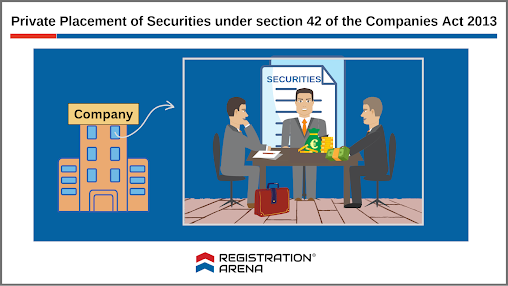
Private Placement of Securities under section 42 of the Companies Act 2013

Image
  Private Placement of Securities under section 42 of the Companies Act 2013 Introduction Companies have various methods of raising share capital, one of which is private placement. It is a technique that involves offering shares or other securities to a designated group of individuals, as determined by the company's board. Unlike a public offering through the issuance of a prospectus, private placement does not involve soliciting the general public. According to a publication by the Reserve Bank of India (RBI), private placement typically involves offering securities to fewer than 50 persons and is exempt from the requirement of filing an offer document with the Securities and Exchange Board of India (SEBI) for review. Definition as per the Companies Act, 2013 Section 42 of the Companies Act talks about the offer or invitation for subscription of securities on private placement. Section 42(3) defines Private Placement as, “Private Placement” means any offer or invitation to ...