Posts

Showing posts with the label Farmer producer company

Quarterly Return Filing and Monthly Payment of Taxes (QRMP) in GST

Image
Quarterly Return Filing and Monthly Payment of Taxes ( QRMP ) in GST To assist small taxpayers with a turnover of less than Rs. 5 crores, the Central Board of Indirect Taxes and Customs (CBIC) introduced the Quarterly Return Filing and Monthly Payment of Taxes (QRMP) scheme under the GST . This scheme allows registered individuals who need to furnish Form GSTR-1 & GSTR-3B and have an aggregate turnover of up to Rupees 5 crores to file GSTR-3B on a quarterly basis and pay tax on a monthly basis. They can do so by using a simple challan in FORM GST PMT-06. The government is empowered under the Central Goods and Services Tax (CGST) Act of 2017 to notify a specific group of registered individuals who must file a return every quarter or part thereof as prescribed in the CGST Rules, 2017.   According to the CGST Act, 2017, notified individuals must pay the tax due to the government within a prescribed time frame, taking into account particulars such as inward and outward suppl...

Difference in Ordinary Resolution vs Special Resolution ?

Image
Ordinary Resolution vs. Special Resolution A resolution is a formal means by which a company record decisions made during a meeting of its members. Most decisions that affect a company are required to be made through a resolution. Additionally, the company's Articles of Association, which serve as its constitution, may contain specific provisions outlining which decisions must be made through a resolution. Ordinary Resolution An ordinary resolution is one that has more votes in favor than against it, with a majority of over 50% of the members, including shareholders or directors, who attend the General Meeting either in person or by proxy. The resolution can be passed by a show of hands, polling, or electronically. Proper notice of the meeting must be given to members, and those who do not participate in voting are not considered. Typically, an ordinary resolution is required to conduct routine business at the Annual General Meeting (AGM). Ordinary resolutions are required f...

Important Key points for Multi-class Trademark Application

Image
Important Key Points for Multi-class Trademark Application Introduction When a Trademark is registered, it legally safeguards the registered brand name from unauthorized usage. The registration of a trademark is determined by the kinds of goods and services offered. The Ministry of Commerce and Industry classifies all goods and services into 45 categories.  To register a brand name under a trademark, it is necessary to know the appropriate trademark category. Additionally, a product may fall into more than one category. Filing separate applications for each category can be a lengthy procedure. What is a Multi-Class Trademark Application? In order to register a service mark or trademark across two or more product or service categories, a multi-class trademark application is used. This type of application enables the applicant to register their trademark in more than one category by filing a single federal trademark application. The most obvious advantage is that the applicant...

Modification of Trademark in India

Image
  Modification of Trademark in India Introduction A trademark is a recognizable symbol, design, or expression that identifies a company's products or services from those of others. It not only represents the brand but also safeguards the company's offerings from unauthorized use by others that could harm its reputation. However, mistakes may occur during the application process for trademark registration due to oversight by the applicant. Fortunately, the Trade Marks Act includes provisions to rectify errors and mistakes in the registration application. In India, it is possible to modify a trademark at any time before or after registration in order to correct any details that may be inaccurate. Modification of Trademark Before Registration After applying for a trademark, if an error or mistake is discovered in the application, the applicant can request to correct it by submitting Form TM-M along with the necessary fee and supporting documents. This is typically done to r...

FAQs on Sole Proprietorship

Image
  FAQs on Sole Proprietorship How much time is required for sole proprietorship registration in India? The length of time required to complete sole proprietorship registration typically takes 7-10 days. However, this duration may vary depending on the specific type of registration being applied for and the processing timeframe of Government Authorities. Do I need to be physically present during this process? No, the registration process for sole proprietorship is entirely conducted online. There is no need for you to be physically present, as all the necessary documents are submitted electronically. To initiate the process, you would only need to provide us with scanned copies of the required forms and documents. Who can be a proprietor of a sole proprietorship firm? Any individual person who is a citizen of India and has the required documents can become a proprietor of a sole proprietorship firm. Is it mandatory to register a sole proprietorship firm in India? Altho...

FAQ on Private Limited Company Registration

Image
  FAQ on Private Limited Company Registration What is the duration required to establish a private limited company in India? The registration process for a Private Limited Company in India typically takes 7-12 days to complete, and involves obtaining two approvals - Name Approval and Final Approval - from government bodies. It is important to note that the duration of this process may vary depending on the workload of the Central Registration Centre (CRC) under the Ministry of Corporate Affairs (MCA). Is my physical presence necessary during this process? The process of company registration is entirely conducted online, thus, physical presence is not required. The necessary documents are filed electronically, and you would only need to send scanned copies of all the required forms and documents to us. Who can be a member of a Private Limited Company? Any individual or organization can become the member/shareholder of the private limited company including foreigners/NRI. ...

FAQ on Nidhi Company Registration

Image
FAQ on Nidhi Company Registration How much time is required for setting up a Nidhi company in India? The registration process for a Nidhi company in India typically takes 7-12 days to complete and requires two approvals from government bodies - Name Approval and Final Approval. However, the duration may vary depending on the workload of the Central Registration Centre (CRC) under the Ministry of Corporate Affairs (MCA). Is physical presence necessary during this process? No, Nidhi company registration is a completely online process. All the required documents are filed electronically, so physical presence is not necessary at all. You would just need to send us scanned copies of all the required documents & forms. Who can be a member of a Nidhi Company? Any individual can become a member/shareholder of a Nidhi limited company including foreigners/NRI. However, such a person must be 18+ above in terms of age and should have a valid PAN card. What is the status of Nidhi Com...

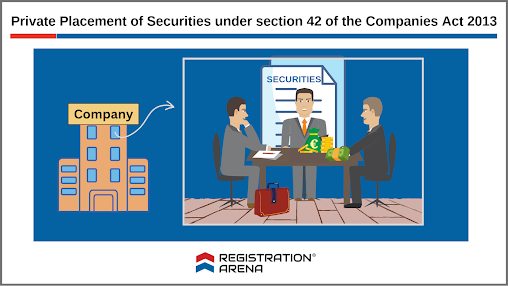
Private Placement of Securities under section 42 of the Companies Act 2013

Image
  Private Placement of Securities under section 42 of the Companies Act 2013 Introduction Companies have various methods of raising share capital, one of which is private placement. It is a technique that involves offering shares or other securities to a designated group of individuals, as determined by the company's board. Unlike a public offering through the issuance of a prospectus, private placement does not involve soliciting the general public. According to a publication by the Reserve Bank of India (RBI), private placement typically involves offering securities to fewer than 50 persons and is exempt from the requirement of filing an offer document with the Securities and Exchange Board of India (SEBI) for review. Definition as per the Companies Act, 2013 Section 42 of the Companies Act talks about the offer or invitation for subscription of securities on private placement. Section 42(3) defines Private Placement as, “Private Placement” means any offer or invitation to ...

Procedure for shifting of registered office from one state to another

Image
  Procedure for shifting of registered office from one state to another What is a ‘Registered Office’? The registered office of a company is its principal place of conducting business as prescribed under Section 12 of the Companies Act, 2013. Promoters decide where the registered office of the company will be situated. All governmental communications with a business are made through its registered office. The state in which the registered office is situated is mentioned in the ‘situation clause’ of the Memorandum of Association. Rules for disclosing Registered Office According to Section 12 of the Companies Act, 2013, companies are required to have a registered office either at the time of starting their business or within 30 days of incorporation. The current regulations also require companies to declare their registered office during incorporation. If a company changes its registered office after incorporation, it must inform the Registrar of Companies within 15 days of th...

Farmer Producer Company Registration

Image
  Farmer Producer Company Registration Farmer Producer Company (FPC) or Farmer Producer Organization (FPO) is an organization that has been designed taking into consideration the requirements of farmers, agriculturists, fishermen, weavers, milk producers, and persons engaged in farming activities, collectively known as ‘Producers’. The main intention of the Farmer Producer Company is to ensure better income for the producers through an organization of their own as the small producers do not have the volume of inputs to get the benefit of agricultural produce on large scale. Additionally, in agricultural marketing, there is a long chain of intermediaries, through which the producers receive only a small part of the value that the ultimate consumer pays. On the other hand, in the Farmer Producer Company, the producers have better bargaining power, bulk buyers of the produce, and bulk suppliers of inputs. Therefore, a Producer Company deals primarily with agriculture and post-ha...