Posts

Showing posts with the label Closure of company

Closing of LLP in India: Steps and Procedure

Image
  Process of c losing an LLP in India  The Limited Liability Partnership (LLP) is a modern type of business entity, established in 2008 by the Limited Liability Partnership Act, that combines the features of a company and a partnership.  In previous articles, we discussed the documents required for LLP registration and the registration process itself.  In this article, we will guide you through the process of closing an LLP in India. Although LLPs offer several advantages over other types of business entities, such as ease of incorporation and limited liability for members, these benefits do not necessarily translate into successful business operations.  This article will explain the Strike Off method of closure and provide an overview of other closure options. The process to close a Limited Liability Partnership An LLP can be closed in two ways: 1. Strike-off method- a. Voluntary Strike Off The LLP should not have been engaged in commercial activities for a p...

How to Obtain a Well-Known Trademark: An Overview

Image
  How to Obtain a Well-Known Trademark In India, over 350,000 trademark applications were filed in the year 2019, and this number is expected to increase rapidly. By 2025, over 600,000 trademark applications are projected to be submitted annually. The Trade Mark Rules 2017 introduced a new process for declaring a trademark as "well-known."  To achieve this status, trademark owners can submit an application (TM-M form) to the Registrar. A well-known trademark receives special protection against infringement and passing off. Recognition as a well-known trademark is based on reputation, both domestically and internationally, and across borders. What is a Well-Known Trademark According to the Trademarks Act of 1999, a well-known trademark is a mark that has gained recognition among a significant portion of the public who use the goods or services associated with the mark.  This recognition is so strong that the use of the mark in relation to other goods or services is likely ...

Importance of claiming a user date in trademark registration application

Image
Significance of claiming a user date in a trademark registration application Trademark Registration in India follows the principle of prior use and first claim. This implies that the person who applies for a brand name first is granted priority for trademark registration. Including a user date in the Trademark Registration application is recommended to safeguard the trademark and prevent any potential infringement. In situations where two identical trademark applications are submitted, the applicant who can prove an earlier date of use is likely to have a stronger case compared to someone who has either applied on a proposed-to-be-used basis or claimed usage on a later date. Therefore, the user date is a crucial factor in securing absolute rights in Trademark registration. What is “User Date” in Registration of Trademark? The term "User Date" refers to the date when a brand name's user started using the name, whether or not the name was registered. For goods, the...

FAQ on Private Limited Company Registration

Image
  FAQ on Private Limited Company Registration What is the duration required to establish a private limited company in India? The registration process for a Private Limited Company in India typically takes 7-12 days to complete, and involves obtaining two approvals - Name Approval and Final Approval - from government bodies. It is important to note that the duration of this process may vary depending on the workload of the Central Registration Centre (CRC) under the Ministry of Corporate Affairs (MCA). Is my physical presence necessary during this process? The process of company registration is entirely conducted online, thus, physical presence is not required. The necessary documents are filed electronically, and you would only need to send scanned copies of all the required forms and documents to us. Who can be a member of a Private Limited Company? Any individual or organization can become the member/shareholder of the private limited company including foreigners/NRI. ...

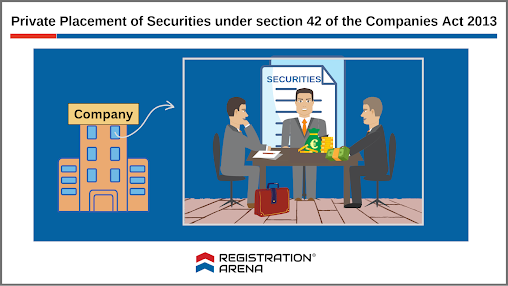
Private Placement of Securities under section 42 of the Companies Act 2013

Image
  Private Placement of Securities under section 42 of the Companies Act 2013 Introduction Companies have various methods of raising share capital, one of which is private placement. It is a technique that involves offering shares or other securities to a designated group of individuals, as determined by the company's board. Unlike a public offering through the issuance of a prospectus, private placement does not involve soliciting the general public. According to a publication by the Reserve Bank of India (RBI), private placement typically involves offering securities to fewer than 50 persons and is exempt from the requirement of filing an offer document with the Securities and Exchange Board of India (SEBI) for review. Definition as per the Companies Act, 2013 Section 42 of the Companies Act talks about the offer or invitation for subscription of securities on private placement. Section 42(3) defines Private Placement as, “Private Placement” means any offer or invitation to ...

Closure of Company in India

Image
  Closure of Company in India In India, the closure of a company is a process of winding up or dissolving the business operations of a company. This can happen due to various reasons, including financial difficulties, lack of profitability, legal issues, retirement of the owners, etc. The process of closure of a company in India is governed by the Companies Act, 2013 and the Insolvency and Bankruptcy Code, 2016. A registered Company may face difficulties to carry out its business operation due to adverse business conditions or lack of finance. Due to such business conditions, the shareholders/directors may lose interest and intention to carry further business activities. The government has given an option for voluntary closure of Company, using which an company may apply to strike off or remove its name from the register, which is maintained by the ROC. It's important to note that the process of closing a company in India can be complex and time-consuming. It's advisable to...