Posts

Showing posts with the label OPC registration

Closing of LLP in India: Steps and Procedure

Image
  Process of c losing an LLP in India  The Limited Liability Partnership (LLP) is a modern type of business entity, established in 2008 by the Limited Liability Partnership Act, that combines the features of a company and a partnership.  In previous articles, we discussed the documents required for LLP registration and the registration process itself.  In this article, we will guide you through the process of closing an LLP in India. Although LLPs offer several advantages over other types of business entities, such as ease of incorporation and limited liability for members, these benefits do not necessarily translate into successful business operations.  This article will explain the Strike Off method of closure and provide an overview of other closure options. The process to close a Limited Liability Partnership An LLP can be closed in two ways: 1. Strike-off method- a. Voluntary Strike Off The LLP should not have been engaged in commercial activities for a p...

Difference between TM (™) and R (®) symbol

Image
Difference between TM ( ™ ) and R ( ® ) symbol We often come across two symbols associated with Trademarks - ‘TM’ and ‘R’. Each symbolizes a different type of trademark. The ‘R’ symbol stands for a Registered Trademark, while ‘TM’ represents an Unregistered Trademark. The trademark itself can be a signature, symbol, logo, design, etc., followed by the symbol in superscript. A trademark is a form of intellectual property that provides the owner with exclusive rights to use and authorize others to use the trademark with the owner's permission, in exchange for adequate consideration. It serves as a means to identify the origin of a product. Registered Trademark A trademark that is officially registered under the Trademarks Act, of 1999 is known as a registered trademark. The registration of a trademark provides the owner with exclusive rights, including the sole use of the mark in relation to their products or services. The registration period for a trademark is ten years, afte...

Change of Partners in Limited Liability Partnership LLP

Image
  Change of Partners in Limited Liability Partnership (LLP) The Limited Liability Partnership  is operated by its partners, who oversee all aspects of the business to achieve its objectives and vision. The addition or departure of partners does not affect the LLP's legal status, but it does impact the business's growth and the remaining partners' responsibilities. Any changes to the partners or their information require approval from the Ministry of Corporate Affairs. The process of adding a partner to an LLP The addition of a new partner to an existing LLP typically requires the approval of all current partners, unless the LLP agreement permits one partner to do so without the others' consent.  To join the LLP, the new partner must express their intention to do so, and after being admitted, the LLP must file Form 4 within 30 days. The form must be signed by an existing designated partner and accompanied by a certificate from a practicing company secretary or charte...

Maintenance & preparation of Statutory Registers

Image
  Preparation and Maintenance of Statutory Registers The Statutory Registers comprise specific records of the Company’s Directors, Shareholders/Members, Loans & Guarantees, Deposits, Shares, etc. These registers are kept at the registered office of the Company. As per the Companies Act 2013, all businesses are required to maintain and update their records. The company should keep accurate documents and statements that depict the organization’s state of affairs at its registered office for each financial year, including all its subsidiaries and other locations. The law mandates the recording of transactions at the company’s registered office and branches, which should be maintained on an accrual basis, using a double-entry bookkeeping system.  Most businesses maintain their statutory registers in a loose-leaf binder or bound book. However, they can be maintained in any format such as a computer record. The Companies Act 2013 necessitates that every company submits these...

Quarterly Return Filing and Monthly Payment of Taxes (QRMP) in GST

Image
Quarterly Return Filing and Monthly Payment of Taxes ( QRMP ) in GST To assist small taxpayers with a turnover of less than Rs. 5 crores, the Central Board of Indirect Taxes and Customs (CBIC) introduced the Quarterly Return Filing and Monthly Payment of Taxes (QRMP) scheme under the GST . This scheme allows registered individuals who need to furnish Form GSTR-1 & GSTR-3B and have an aggregate turnover of up to Rupees 5 crores to file GSTR-3B on a quarterly basis and pay tax on a monthly basis. They can do so by using a simple challan in FORM GST PMT-06. The government is empowered under the Central Goods and Services Tax (CGST) Act of 2017 to notify a specific group of registered individuals who must file a return every quarter or part thereof as prescribed in the CGST Rules, 2017.   According to the CGST Act, 2017, notified individuals must pay the tax due to the government within a prescribed time frame, taking into account particulars such as inward and outward suppl...

How to Choose the Best Business Structure for Your Start-up?

Image
  How to Choose the Best Business Structure for Your Start-up? Introduction Selecting the appropriate legal structure for your company is among the most critical choices you will need to make at the outset of your business. Your selection will impact not just your tax payments but also the amount of documentation that your company will need to undertake and your own personal responsibility. Therefore, how can you determine which business structure is best for your new venture? To decide which business structure is suitable for your startup, you need to assess various aspects such as liability, tax implications, incorporation expenses, and ongoing administration and record-keeping requirements. In this blog, we will describe various business structures that you can adopt for your business. Sole Proprietorship The simplest form of business structure is  Sole Proprietorship , which typically involves a single individual who owns and runs the business. If you don't establi...

Alteration of Memorandum of Association

Image
Alteration of Memorandum of Association The Memorandum of Association (MOA) is a legal document that sets out the constitution of a company and defines the company's objectives, powers, and scope of operations. The MOA is one of the documents required to be filed with the registrar of companies during the incorporation process. The MOA is a vital document that outlines the purpose of the company, its goals, and how it intends to operate. Types of MOA as per companies act 2013 As notified under Schedule I of the companies act 2013 following are the types of MOA that different types of companies can adopt: Table A: Company limited by shares Table B: Company limited by guarantee and having a share capital Table C: Company limited by guarantee and not having a share capital Table D: Unlimited company having a share capital Table E: Unlimited company not having a share capital The MOA mainly consists of the following clauses: Name clause–   The name clause generally co...

Private Placement of Securities under section 42 of the Companies Act 2013

Image
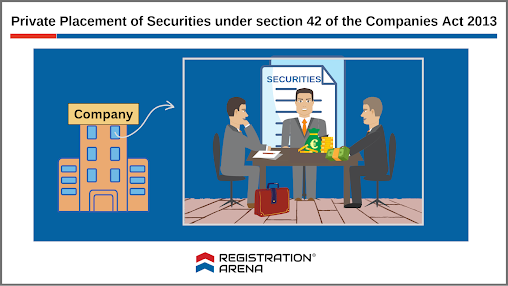
  Private Placement of Securities under section 42 of the Companies Act 2013 Introduction Companies have various methods of raising share capital, one of which is private placement. It is a technique that involves offering shares or other securities to a designated group of individuals, as determined by the company's board. Unlike a public offering through the issuance of a prospectus, private placement does not involve soliciting the general public. According to a publication by the Reserve Bank of India (RBI), private placement typically involves offering securities to fewer than 50 persons and is exempt from the requirement of filing an offer document with the Securities and Exchange Board of India (SEBI) for review. Definition as per the Companies Act, 2013 Section 42 of the Companies Act talks about the offer or invitation for subscription of securities on private placement. Section 42(3) defines Private Placement as, “Private Placement” means any offer or invitation to ...

Online Closure of Limited Liability Partnership (LLP) in India

Image
Online Closure of LLP The process of online closure of a Limited Liability Partnership (LLP) in India is similar to the process of closing a company, with the difference being that it is carried out primarily through the Ministry of Corporate Affairs' (MCA) online portal, MCA21. Here is the general process of online closure of an LLP in India. A registered LLP may face difficulties in carrying out its business operation due to adverse business conditions or lack of finance. Due to such business conditions, the partners may lose interest and intention to carry out further business activities. The government has given an option for voluntary closure of LLP, using which an LLP may apply to strike off or remove its name from the register, which is maintained by the ROC. It is one of the easier, faster, and less economical methods of Closing an LLP. It's important to note that the process of online closure of an LLP in India can be complex, and it's advisable to seek the a...

Annual Compliance for LLP

Image
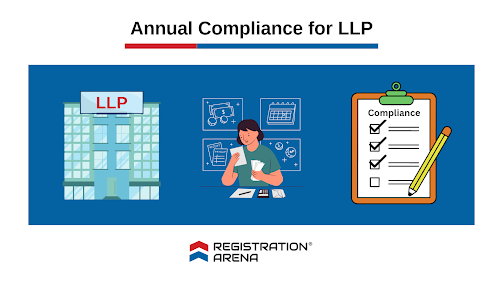
Annual Compliance for LLP An LLP incorporated under LLP Act 2008 has to comply with different laws provided by authorities such as the Ministry of Corporate Affairs (MCA), Income Tax Department, GST Departments, etc. Annual Compliance of LLP is all about bookkeeping and accounting, auditing, payment of taxes, regular filing of annual returns, financial statements, Designated Partners KYC, and all other compliances as required from time to time. Every LLP incorporated in India irrespective of its size and turnover has to carry out annual compliances as applicable. An LLP is required to manage various operations in day-to-day business in line with the complex corporate and tax laws, which can be sometimes a difficult task. Therefore, it is advisable to carry out various activities under the guidance of a professional for understanding the legal requirements and timely fulfillment of the compliances so as to avoid penalties and fines. Advantages Of Annual Compliance for LLP Get an...

Annual Compliance for Private Limited Company

Image
Annual Compliance for Private Limited Company A private limited incorporated under the Companies Act 2013 has to comply with different laws delivered by authorities such as the Ministry of Corporate Affairs (MCA), Income Tax Department, GST Departments, etc. Annual Compliance is all about bookkeeping and accounting, auditing, holding meetings of directors and members, regular filing of annual returns, financial statements, Directors' KYC, payment of taxes, and other compliances as required from time to time. Every private limited company incorporated in India irrespective of its size and turnover has to carry out annual compliances as applicable to it.  A company must manage various operations in day-to-day business in line with the complex corporate and tax laws, which can be a difficult task. Therefore, it is advisable to carry out various activities under the guidance of a professional to understand the legal requirements and timely fulfillment of the compliances so as to avoi...