Posts

Showing posts with the label GST Filings

Quarterly Return Filing and Monthly Payment of Taxes (QRMP) in GST

Image
Quarterly Return Filing and Monthly Payment of Taxes ( QRMP ) in GST To assist small taxpayers with a turnover of less than Rs. 5 crores, the Central Board of Indirect Taxes and Customs (CBIC) introduced the Quarterly Return Filing and Monthly Payment of Taxes (QRMP) scheme under the GST . This scheme allows registered individuals who need to furnish Form GSTR-1 & GSTR-3B and have an aggregate turnover of up to Rupees 5 crores to file GSTR-3B on a quarterly basis and pay tax on a monthly basis. They can do so by using a simple challan in FORM GST PMT-06. The government is empowered under the Central Goods and Services Tax (CGST) Act of 2017 to notify a specific group of registered individuals who must file a return every quarter or part thereof as prescribed in the CGST Rules, 2017.   According to the CGST Act, 2017, notified individuals must pay the tax due to the government within a prescribed time frame, taking into account particulars such as inward and outward suppl...

Importance of claiming a user date in trademark registration application

Image
Significance of claiming a user date in a trademark registration application Trademark Registration in India follows the principle of prior use and first claim. This implies that the person who applies for a brand name first is granted priority for trademark registration. Including a user date in the Trademark Registration application is recommended to safeguard the trademark and prevent any potential infringement. In situations where two identical trademark applications are submitted, the applicant who can prove an earlier date of use is likely to have a stronger case compared to someone who has either applied on a proposed-to-be-used basis or claimed usage on a later date. Therefore, the user date is a crucial factor in securing absolute rights in Trademark registration. What is “User Date” in Registration of Trademark? The term "User Date" refers to the date when a brand name's user started using the name, whether or not the name was registered. For goods, the...

How to Choose the Best Business Structure for Your Start-up?

Image
  How to Choose the Best Business Structure for Your Start-up? Introduction Selecting the appropriate legal structure for your company is among the most critical choices you will need to make at the outset of your business. Your selection will impact not just your tax payments but also the amount of documentation that your company will need to undertake and your own personal responsibility. Therefore, how can you determine which business structure is best for your new venture? To decide which business structure is suitable for your startup, you need to assess various aspects such as liability, tax implications, incorporation expenses, and ongoing administration and record-keeping requirements. In this blog, we will describe various business structures that you can adopt for your business. Sole Proprietorship The simplest form of business structure is  Sole Proprietorship , which typically involves a single individual who owns and runs the business. If you don't establi...

Modification of Trademark in India

Image
  Modification of Trademark in India Introduction A trademark is a recognizable symbol, design, or expression that identifies a company's products or services from those of others. It not only represents the brand but also safeguards the company's offerings from unauthorized use by others that could harm its reputation. However, mistakes may occur during the application process for trademark registration due to oversight by the applicant. Fortunately, the Trade Marks Act includes provisions to rectify errors and mistakes in the registration application. In India, it is possible to modify a trademark at any time before or after registration in order to correct any details that may be inaccurate. Modification of Trademark Before Registration After applying for a trademark, if an error or mistake is discovered in the application, the applicant can request to correct it by submitting Form TM-M along with the necessary fee and supporting documents. This is typically done to r...

FAQs on Sole Proprietorship

Image
  FAQs on Sole Proprietorship How much time is required for sole proprietorship registration in India? The length of time required to complete sole proprietorship registration typically takes 7-10 days. However, this duration may vary depending on the specific type of registration being applied for and the processing timeframe of Government Authorities. Do I need to be physically present during this process? No, the registration process for sole proprietorship is entirely conducted online. There is no need for you to be physically present, as all the necessary documents are submitted electronically. To initiate the process, you would only need to provide us with scanned copies of the required forms and documents. Who can be a proprietor of a sole proprietorship firm? Any individual person who is a citizen of India and has the required documents can become a proprietor of a sole proprietorship firm. Is it mandatory to register a sole proprietorship firm in India? Altho...

FAQ on Private Limited Company Registration

Image
  FAQ on Private Limited Company Registration What is the duration required to establish a private limited company in India? The registration process for a Private Limited Company in India typically takes 7-12 days to complete, and involves obtaining two approvals - Name Approval and Final Approval - from government bodies. It is important to note that the duration of this process may vary depending on the workload of the Central Registration Centre (CRC) under the Ministry of Corporate Affairs (MCA). Is my physical presence necessary during this process? The process of company registration is entirely conducted online, thus, physical presence is not required. The necessary documents are filed electronically, and you would only need to send scanned copies of all the required forms and documents to us. Who can be a member of a Private Limited Company? Any individual or organization can become the member/shareholder of the private limited company including foreigners/NRI. ...

FAQ on Nidhi Company Registration

Image
FAQ on Nidhi Company Registration How much time is required for setting up a Nidhi company in India? The registration process for a Nidhi company in India typically takes 7-12 days to complete and requires two approvals from government bodies - Name Approval and Final Approval. However, the duration may vary depending on the workload of the Central Registration Centre (CRC) under the Ministry of Corporate Affairs (MCA). Is physical presence necessary during this process? No, Nidhi company registration is a completely online process. All the required documents are filed electronically, so physical presence is not necessary at all. You would just need to send us scanned copies of all the required documents & forms. Who can be a member of a Nidhi Company? Any individual can become a member/shareholder of a Nidhi limited company including foreigners/NRI. However, such a person must be 18+ above in terms of age and should have a valid PAN card. What is the status of Nidhi Com...

Private Placement of Securities under section 42 of the Companies Act 2013

Image
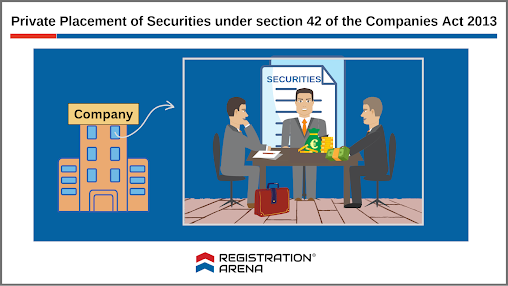
  Private Placement of Securities under section 42 of the Companies Act 2013 Introduction Companies have various methods of raising share capital, one of which is private placement. It is a technique that involves offering shares or other securities to a designated group of individuals, as determined by the company's board. Unlike a public offering through the issuance of a prospectus, private placement does not involve soliciting the general public. According to a publication by the Reserve Bank of India (RBI), private placement typically involves offering securities to fewer than 50 persons and is exempt from the requirement of filing an offer document with the Securities and Exchange Board of India (SEBI) for review. Definition as per the Companies Act, 2013 Section 42 of the Companies Act talks about the offer or invitation for subscription of securities on private placement. Section 42(3) defines Private Placement as, “Private Placement” means any offer or invitation to ...

Farmer Producer Company Registration

Image
  Farmer Producer Company Registration Farmer Producer Company (FPC) or Farmer Producer Organization (FPO) is an organization that has been designed taking into consideration the requirements of farmers, agriculturists, fishermen, weavers, milk producers, and persons engaged in farming activities, collectively known as ‘Producers’. The main intention of the Farmer Producer Company is to ensure better income for the producers through an organization of their own as the small producers do not have the volume of inputs to get the benefit of agricultural produce on large scale. Additionally, in agricultural marketing, there is a long chain of intermediaries, through which the producers receive only a small part of the value that the ultimate consumer pays. On the other hand, in the Farmer Producer Company, the producers have better bargaining power, bulk buyers of the produce, and bulk suppliers of inputs. Therefore, a Producer Company deals primarily with agriculture and post-ha...

Online Closure of Limited Liability Partnership (LLP) in India

Image
Online Closure of LLP The process of online closure of a Limited Liability Partnership (LLP) in India is similar to the process of closing a company, with the difference being that it is carried out primarily through the Ministry of Corporate Affairs' (MCA) online portal, MCA21. Here is the general process of online closure of an LLP in India. A registered LLP may face difficulties in carrying out its business operation due to adverse business conditions or lack of finance. Due to such business conditions, the partners may lose interest and intention to carry out further business activities. The government has given an option for voluntary closure of LLP, using which an LLP may apply to strike off or remove its name from the register, which is maintained by the ROC. It is one of the easier, faster, and less economical methods of Closing an LLP. It's important to note that the process of online closure of an LLP in India can be complex, and it's advisable to seek the a...

Closure of Company in India

Image
  Closure of Company in India In India, the closure of a company is a process of winding up or dissolving the business operations of a company. This can happen due to various reasons, including financial difficulties, lack of profitability, legal issues, retirement of the owners, etc. The process of closure of a company in India is governed by the Companies Act, 2013 and the Insolvency and Bankruptcy Code, 2016. A registered Company may face difficulties to carry out its business operation due to adverse business conditions or lack of finance. Due to such business conditions, the shareholders/directors may lose interest and intention to carry further business activities. The government has given an option for voluntary closure of Company, using which an company may apply to strike off or remove its name from the register, which is maintained by the ROC. It's important to note that the process of closing a company in India can be complex and time-consuming. It's advisable to...

Annual Compliance for LLP

Image
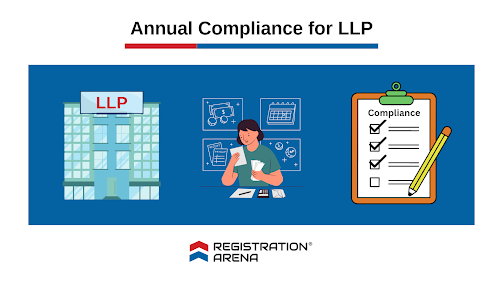
Annual Compliance for LLP An LLP incorporated under LLP Act 2008 has to comply with different laws provided by authorities such as the Ministry of Corporate Affairs (MCA), Income Tax Department, GST Departments, etc. Annual Compliance of LLP is all about bookkeeping and accounting, auditing, payment of taxes, regular filing of annual returns, financial statements, Designated Partners KYC, and all other compliances as required from time to time. Every LLP incorporated in India irrespective of its size and turnover has to carry out annual compliances as applicable. An LLP is required to manage various operations in day-to-day business in line with the complex corporate and tax laws, which can be sometimes a difficult task. Therefore, it is advisable to carry out various activities under the guidance of a professional for understanding the legal requirements and timely fulfillment of the compliances so as to avoid penalties and fines. Advantages Of Annual Compliance for LLP Get an...

Annual Compliance for Private Limited Company

Image
Annual Compliance for Private Limited Company A private limited incorporated under the Companies Act 2013 has to comply with different laws delivered by authorities such as the Ministry of Corporate Affairs (MCA), Income Tax Department, GST Departments, etc. Annual Compliance is all about bookkeeping and accounting, auditing, holding meetings of directors and members, regular filing of annual returns, financial statements, Directors' KYC, payment of taxes, and other compliances as required from time to time. Every private limited company incorporated in India irrespective of its size and turnover has to carry out annual compliances as applicable to it.  A company must manage various operations in day-to-day business in line with the complex corporate and tax laws, which can be a difficult task. Therefore, it is advisable to carry out various activities under the guidance of a professional to understand the legal requirements and timely fulfillment of the compliances so as to avoi...